California is rewriting what counts as serving a summons.
A defendant learned about a $486,528 default judgment in 2020, when his wages were garnished. The California Supreme Court held in 2024 that no deadline barred his challenge. The Legislature then rewrote the service statutes: three attempts, photographs with GPS stamps, and a burden of proof that now falls on the party holding the default. It takes effect January 1, 2027.
By Helena Harper, Editorial Director
A garnishment, nine years late
In January 2020, the Placer County sheriff served an earnings withholding order on Cory Michael Hoehn's employer. That is how he learned there was a judgment against him, entered in April 2011 for $486,528. It arose from a fire that destroyed an apartment building he had leased in June 2009, after the building's insurer sued him and his roommate for general negligence.
The affidavit of service said the summons and complaint had been left in March 2010 with a woman identified as Hoehn's girlfriend, co-occupant, and a competent member of the household, with a copy mailed to his address. That is substituted service under Code of Civil Procedure section 415.20(b). Hoehn's declaration said the woman did not live with him and that he never received anything. By then the judgment had been assigned to a third party and a writ of execution had issued. He moved to set it aside in March 2020, roughly nine years after entry.
What the Supreme Court decided
Section 473(d) says a court may set aside a void judgment on motion of either party. A line of Court of Appeal decisions had grafted a deadline onto it: where a judgment is not void on its face, and its invalidity must be shown with evidence from outside the record, the motion had to come within a reasonable time, and the outer limit borrowed for that was the two-year period in section 473.5. The trial court applied it to Hoehn and denied his motion. The Court of Appeal affirmed.
On November 18, 2024, in California Capital Insurance Company v. Hoehn, No. S277510, the Supreme Court of California reversed. Writing for a unanimous court, Justice Jenkins concluded that the judicially created rule "finds no footing in the statute's text," had not been adopted by the Legislature, and lacked sound justification. A motion to vacate a judgment that is void for want of proper service is therefore not cut off by the borrowed two-year limit.
What the Legislature then did
Hoehn resolved when a defective service could be challenged. It did not change what service requires or what a process server has to document. Assembly Bill 747, the Service of Process Accountability, Reform and Equity Act, does both. It was approved and chaptered on October 10, 2025 as Chapter 563 of the Statutes of 2025. Starting January 1, 2027, it changes the requirements for substituted service, proof of service of summons, service of an unlawful detainer summons by posting and mailing, and entry of default.
Substituted service under section 415.20(b) is available only where personal service cannot be made with reasonable diligence, a phrase the statute never defined. AB 747 defines it. A party shows reasonable diligence by attempting personal delivery "in good faith, on at least three occasions," on three different days at three different times. Where the action is to collect consumer debt, at least one attempt must be made at the person's dwelling place or usual place of abode, if that location is known or could be determined with reasonable effort. Section 415.45, governing service of an unlawful detainer summons by posting and mailing, gets the same three-attempt standard.
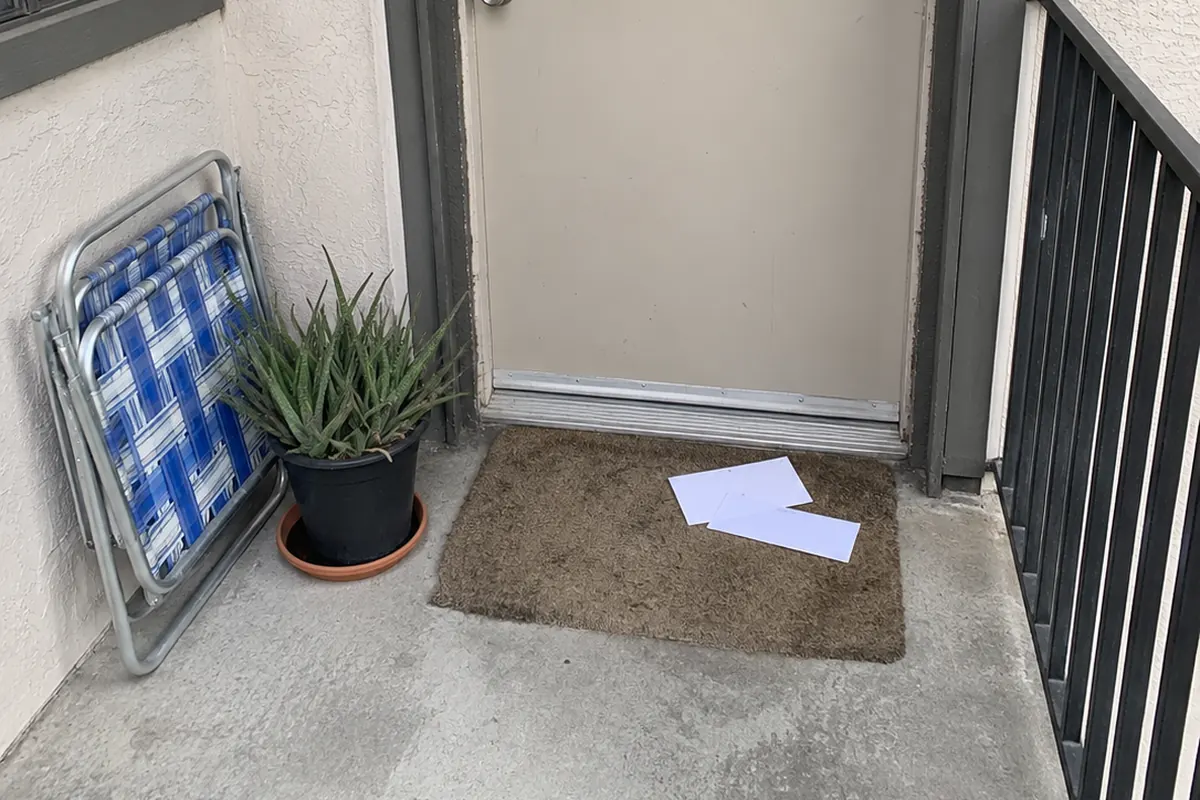
The change practitioners are likely to feel first is in section 417.10. Proof of service by personal delivery or substituted service, and proof of service of an unlawful detainer summons by posting and mailing, must include one or more photographs of the site of each effected or attempted service, taken as close as reasonably practicable to the attempt. Each must carry a readable stamp that automatically records the date, time, and GPS or equivalent coordinates. At a residence or business, it must show the door, or the entrance to the building or office if the door is not reasonably accessible. Where no signal is available, or where the server reasonably judges that taking a photograph would compromise their safety, the statute substitutes a detailed written explanation.
Two further pieces sit at the back end. Section 585(b) is amended to state that the clerk cannot enter a default without proof of service of the summons, conforming it to section 585(a). And a new section 473.2 lets a party who was not served move to set aside or vacate the default or default judgment and for leave to defend or to move for dismissal. On that motion, the party that sought the default bears the burden of proving lawful service by a preponderance of the evidence, and the court is directed to take evidence on the lawfulness of service and not to deny a reasonable request by either side for a hearing with oral testimony. Business and Professions Code section 22355 is separately amended so that the county clerk's register of process servers is publicly available.
The change that already happened
A companion measure has been in force since the start of this year. Senate Bill 85, Chapter 403 of the Statutes of 2025, amended Code of Civil Procedure section 413.30 effective January 1, 2026. A plaintiff who, despite reasonable diligence, cannot serve by any method authorized in sections 413.10 through 417.40 may ask the court to permit service another way, and the court may authorize any manner reasonably calculated to give actual notice, with email and other electronic technology named as possibilities. The showing is not a formality: the plaintiff must detail all attempts by each statutory method and why each failed at every address where the defendant is likely to be found. Section 413.30 does not reach actions against governmental entities, or their agents or employees sued in an official or individual capacity.
The forms are still being built
Much of AB 747 runs through Judicial Council forms. In invitation to comment SPR26-08, the council's Civil and Small Claims Advisory Committee circulated a proposal to amend California Rules of Court 3.1150, 3.1160, and 3.1372, adopt two mandatory forms, approve one optional form, and revise thirteen forms, with a proposed effective date of January 1, 2027. Comments were due May 18, 2026. The invitation states on its face that the proposal had not been approved by the council and was circulated for comment only, and no record of a final adoption was located at the time of writing. Parallel invitations covered family law, probate, and unlawful detainer forms.
One proposed amendment marks a boundary. Those three rules require certain papers, including preliminary injunction orders to show cause and protective order documents in civil harassment and elder abuse proceedings, to be served in the manner provided for a summons, which routes their proofs through section 417.10. The committee proposed saying those proofs need not include the photographs, reasoning that the requirement was aimed at fraudulent service in debt collection and unlawful detainer matters, and that photographing a restrained person's home could endanger the server or the protected person.
Three consequences for practicing attorneys
What the new statutes change in day-to-day practice:
Diligence becomes a count, not an argument
Substituted service and unlawful detainer posting will require personal delivery attempted in good faith on at least three occasions, on three different days, at three different times. In consumer debt actions, at least one of those attempts has to be at the person's dwelling place or usual place of abode if it is known or can be found with reasonable effort.
The proof of service turns into an exhibit
Proofs will have to carry photographs of the site of each effected or attempted service, each with a readable stamp that automatically records date, time, and GPS or equivalent coordinates. No signal means a written explanation. A safety concern means a written explanation. Neither is a box to check.
A default is only as durable as its service
Under the new section 473.2, when a party who was not served moves to vacate, the party that obtained the default carries the burden of proving lawful service by a preponderance of the evidence, and the court is directed not to refuse a reasonable request for a hearing with oral testimony.
What stays the same
The architecture of service is untouched. Personal delivery remains the preferred method, substituted service remains available for corporations and other entities without any diligence showing under section 415.20(a), and a defendant who was properly served and simply failed to appear is in the same position as before. What changes is the evidentiary record a plaintiff builds along the way, and who has to produce it when service is questioned years later.
For most civil matters, service of process is the least examined step in the case. It is delegated, documented on a one-page form, and never looked at again unless something goes wrong.
After January 1, 2027, that one page is a photograph, a timestamp, a set of coordinates, and a count of three. Firms that handle default-prone matters have a little under four months to find out whether the vendors they use can produce it.
Archivar
The Archivar Editorial Desk
Fact-checked against the authorities listed below. This article is for general informational purposes and is not legal advice.
Sources: California Capital Insurance Company v. Hoehn, No. S277510, Supreme Court of California, filed November 18, 2024 (slip opinion, California Courts); Assembly Bill 747 (Service of Process Accountability, Reform and Equity Act), Statutes of 2025, Chapter 563, California Legislative Information; Senate Bill 85, Statutes of 2025, Chapter 403, California Legislative Information; Code of Civil Procedure sections 413.30, 415.20, 415.45, 417.10, 473, 473.2, 473.5, and 585, and Business and Professions Code section 22355; Invitation to Comment SPR26-08, "Civil Practice and Procedure: Rules and Forms to Implement Changes in Law Regarding Civil Summons," Civil and Small Claims Advisory Committee, Judicial Council of California, comment deadline May 18, 2026. Statutory language quoted in this article is quoted from the code sections as set out in that invitation to comment. The SPR26-08 proposal had not been approved by the Judicial Council when it was circulated, and no record of a final adoption was located at the time of writing.