Oregon's high court says a hallway glimpse of a shackled client called for a mistrial motion.
In Nelson v. Cain, decided October 1, 2026, the Oregon Supreme Court held that a defense lawyer gave inadequate assistance by not moving for a mistrial after jurors saw his client restrained outside the courtroom. One justice dissented.
By Nathaniel Cross, Staff Writer
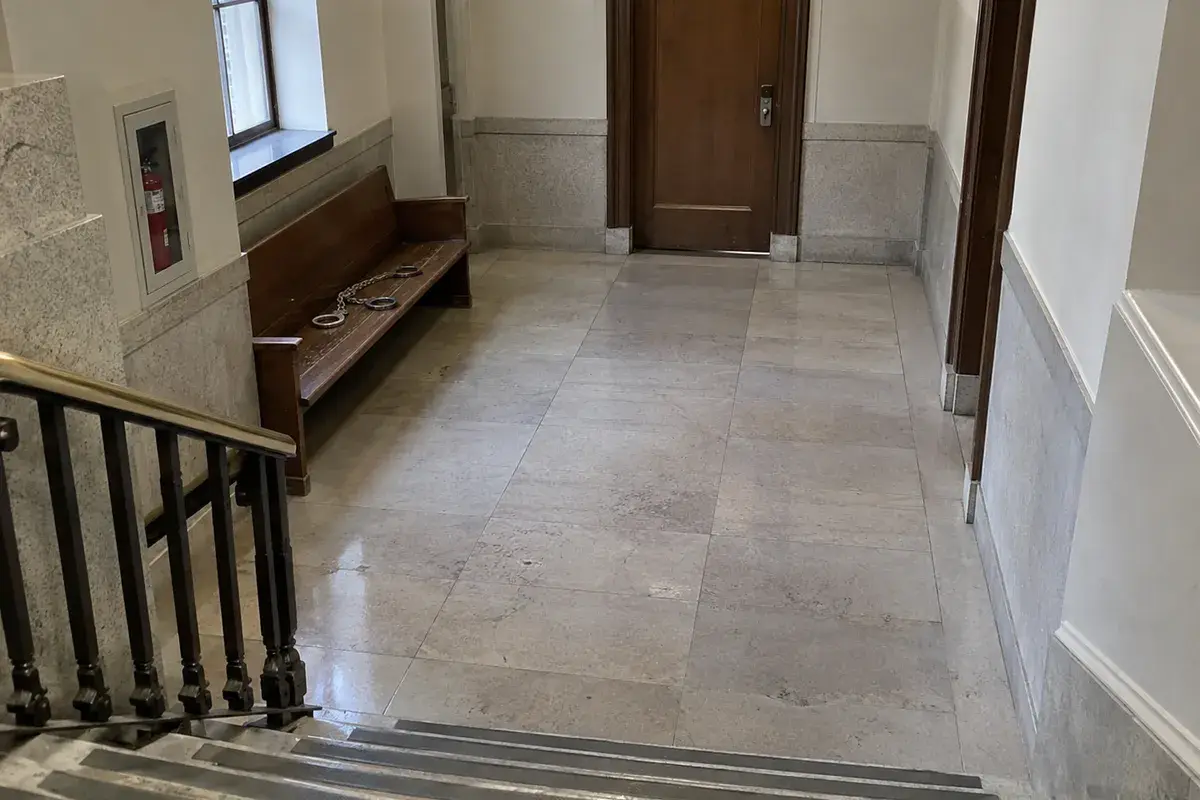
Jurors saw Nelson in restraints during the 2013 retrial
At least three jurors saw Quandray J. Nelson in a courthouse hallway while the jury was deliberating in his 2013 retrial. Two sheriff's deputies were leading him from a holding cell to transport him back to jail. He wore a blue jumpsuit, handcuffs and ankle restraints attached to a belly chain. All of the restraints were visible.
The jury had begun deliberating on Friday, April 12, 2013, but had not reached a verdict. Four or five jurors were walking down the stairs toward the courthouse exit when they saw Nelson. The deputies pulled him back into the holding cell for about ten minutes.
Nelson told his lawyer about the sighting on Monday, April 15. The lawyer said he made inquiries of the deputies and brought the matter to the court's attention. The post-conviction court found that the issue was discussed in chambers, off the record.
Counsel did not move for a mistrial. He did not request that the jurors be questioned. He made no objection and created no record of the discussion. The jury returned guilty verdicts that day on first-degree rape and sexual abuse charges arising from a domestic violence incident.
The Supreme Court found no recorded strategic choice
The Oregon Supreme Court held that counsel's failure to seek relief fell below the required standard of professional skill and judgment. The court treated Article I, section 11, of the Oregon Constitution as functionally equivalent to the Sixth Amendment standard from Strickland v. Washington.
Oregon's test has two parts. A petitioner must show that counsel failed to exercise reasonable professional skill and judgment. The petitioner must also show prejudice. In Oregon, prejudice means that the failure had a "tendency to affect the outcome," which is "more than mere possibility, but less than probability," under Green v. Franke, 357 Or 301 (2015).
The court acknowledged that no Oregon appellate decision in 2013 had held that an out-of-court sighting of a defendant in shackles impaired the right to an impartial jury. It did not treat that absence as dispositive.
Oregon shackling law, including State v. Smith from 1883 and State v. Kessler, 57 Or App 469 (1982), established that unjustified shackling before the jury can support a mistrial. Nothing in those decisions limited the rule to the courtroom. As the court quoted Kessler, the question is "whether they see the shackles at all."
Under Burdge v. Palmateer, 338 Or 490 (2005), counsel can provide inadequate assistance by failing to raise an unsettled argument that would obviously benefit the client. The Supreme Court said the record showed no evidence that counsel actually considered and rejected a mistrial motion. It declined to supply a post hoc strategic rationale.
A failed motion could still have protected the trial
The court also rejected the idea that counsel could reasonably avoid a motion because it might fail. An unsuccessful motion would not have left Nelson worse off, the court said. It could have prompted other protective measures.
The court applied the more-than-a-mere-possibility standard and held that there was more than a mere possibility the trial court would have granted a mistrial or taken other steps if counsel had asked. The risk that jurors perceived Nelson as dangerous was closely tied to a disputed issue at trial, whether force was used.
The court did not hold that every hallway sighting requires a mistrial. It did not adopt the presumption of prejudice Nelson requested. It also expressly declined to decide whether in-court and out-of-court sightings differ in a material way for constitutional purposes.
Decisions from other jurisdictions treating hallway sightings as not inherently prejudicial did not change the result. The court described the reasoning in several of them as "somewhat cursory and not particularly persuasive."
Walton shows what a recorded response can look like
The court relied on State v. Walton, 311 Or 223 (1991), as a comparison. In Walton, counsel moved for a mistrial after a juror and an alternate saw the defendant in handcuffs.
The trial court denied the motion, but questioned the jurors, gave a curative instruction and offered to replace the juror. The Oregon Supreme Court upheld that result. In Nelson, the court said Walton showed the protective measures available when counsel makes a motion.
That distinction mattered. The issue in Nelson was not only what the trial judge might have done. It was also what counsel failed to request and what the record failed to preserve. Raising the matter informally in chambers did not satisfy counsel's duty in this case.
Before publication, the Archivar editorial desk read the full opinion, majority and dissent, rather than relying on news summaries, and noted that the seven-year gap between the 2013 retrial and the 2020 post-conviction trial is exactly what the dissent says left the factual record thin.
The dissent focused on the thin record
Justice Stephen Bushong dissented. Justice James did not participate, and a judge sat as justice pro tempore. The decision was 6-1.
Bushong said Nelson carried the burden of proof and that the record was sparse because the criminal trial occurred in 2013 and the post-conviction trial occurred in 2020. The dissent noted there was no evidence that the jurors recognized the shackled man as Nelson.
It also said counsel may have investigated the hallway sighting and concluded there was no reason to move for a mistrial. The dissent would have required Nelson to show that the trial court would have granted the motion to establish prejudice.
The decision came on review from Nelson v. Cain, 334 Or App 326 (2024), which had affirmed the Malheur County Circuit Court's denial of post-conviction relief. The Supreme Court reversed the circuit court's judgment, reversed the Court of Appeals in part and remanded for further proceedings. Only the shackling claim was before the Supreme Court. The other claims were left undisturbed.
Oregon lawyers must put the issue on the record
For Oregon defense counsel, the holding puts a specific event on notice: when jurors see a client restrained outside the courtroom in circumstances like these, the opinion treats a mistrial motion on the record as the only reasonable course. A private discussion in chambers did not suffice here.
Trial judges retain options short of a mistrial. As Walton illustrates, those options can include questioning jurors, giving a curative instruction or replacing a juror. Counsel's motion gives the court an opportunity to choose among those measures and creates a record for later review.
Prosecutors and courts also must account for transport logistics. The timing and location of moving a restrained defendant through areas used by jurors now form part of the constitutional picture in Oregon.
Archivar, which publishes The Docket, is an operating system for law firms that answers every call 24/7 in English and Spanish, runs intake, manages matters and remembers everything the firm does. The case turned on what was and was not written down.
Nelson is an Oregon state-law decision under Article I, section 11. Other jurisdictions apply their own standards. The Supreme Court left open the broader question whether in-court and out-of-court sightings have a material constitutional difference.
The jurors saw him on the stairs, not in the courtroom.
The lawyer raised it in chambers, not on the record.
The court said the second fact mattered more than the first.
The holding
Not moving for a mistrial after jurors saw the defendant shackled in a hallway was inadequate assistance under Article I, section 11.
Off the record was not enough
Counsel raised the sighting in chambers but made no motion, no objection and no record. The court found that fell short.
What stays open
The court did not adopt a presumption of prejudice or decide whether in-court and hallway sightings differ constitutionally.
What happens next
The post-conviction judgment was reversed and the case remanded to Malheur County Circuit Court for further proceedings.
Archivar
The Archivar Editorial Desk
Every date, citation, vote and quotation above was checked against the Oregon Supreme Court's slip opinion in Nelson v. Cain, majority and dissent, and cross-checked with independent reporting on the decision. The case was remanded for further proceedings, so later developments may follow. This article is general information, not legal advice.
Sources: Oregon Supreme Court, Nelson v. Cain, 375 Or 614, No. S071389 (October 1, 2026), majority opinion by Justice DeHoog and dissent by Justice Bushong; Oregon Court of Appeals, Nelson v. Cain, 334 Or App 326 (2024); ABA Journal, report on the decision (October 6, 2026); Oregon Capital Chronicle, report on the decision (October 5, 2026); Justia, opinion summary of Nelson v. Cain.