The advertisement that a court turned into a contract.
In 1891 a company promised £100 to anyone who used its flu remedy and caught influenza anyway. When a London woman did exactly that and sued, the court gave English law its most famous lesson in when an advertisement stops being sales talk and becomes a binding promise.
By Helena Harper, Editorial Director
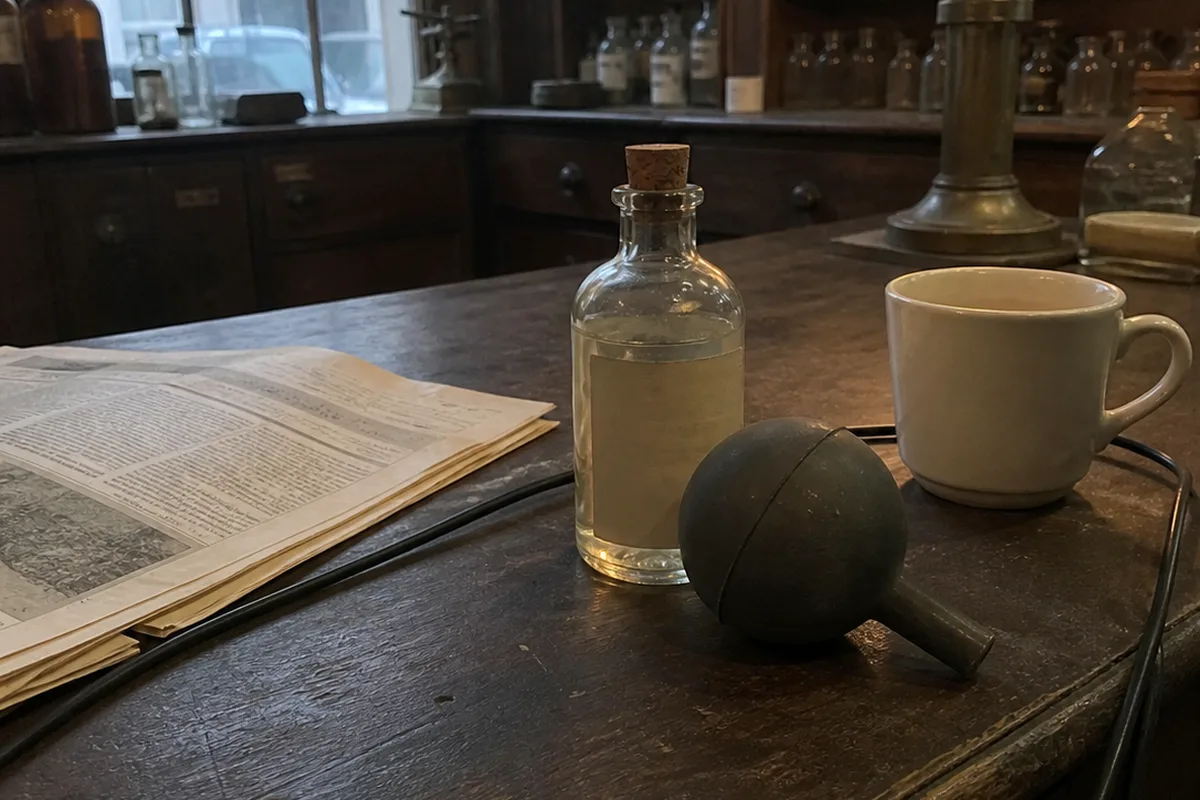
A remedy, a reward, and a woman who read the fine print
In the winter of 1891, with an influenza epidemic moving through Britain, the Carbolic Smoke Ball Company sold a cure. The product was a small hollow rubber ball filled with carbolic acid, fitted with a tube you put to the nose and squeezed, releasing a vapour the maker claimed would ward off colds and flu. On 13 November 1891, the company ran an advertisement in the Pall Mall Gazette and other papers making an unusually bold promise: it would pay £100 to anyone who used the ball three times a day for two weeks, exactly as directed, and still caught influenza. To prove it was serious, the advertisement said the company had deposited £1,000 with the Alliance Bank on Regent Street, "shewing our sincerity in the matter."
A woman named Louisa Elizabeth Carlill read the advertisement, bought a smoke ball, and used it faithfully, three times a day, from mid-November until she came down with influenza in the middle of January 1892. She wrote to claim her £100. The company refused to pay. She sued, and the case that resulted, Carlill v Carbolic Smoke Ball Co, reported at [1893] 1 QB 256, became the single most famous decision in the common law of contract, taught to first-year law students across the English-speaking world to this day.
The company's defences, one after another
The Carbolic Smoke Ball Company did not go quietly. Its lawyers, including at trial the future prime minister H.H. Asquith, argued nearly every way a promise could fail to be a contract. The advertisement, they said, was mere sales "puff," the kind of loose boast no reasonable person treats as a serious commitment. It was too vague: it never said how long after use the flu had to strike, so in theory a buyer could claim years later. It was, they suggested, really a bet, void as a wagering contract, or else an insurance policy that failed to meet the form the law required. And even if it were an offer, Mrs. Carlill had never told the company she accepted it before quietly using the ball at home, so no contract was ever formed.
Each argument aimed at a different link in the chain that turns words into a binding agreement: intention, certainty, the type of contract, and acceptance. The courts worked through them one by one. Mr. Justice Hawkins found for Mrs. Carlill at trial on 4 July 1892, and the company appealed. On 7 December 1892 the Court of Appeal, Lord Justices Lindley, Bowen, and A.L. Smith, unanimously dismissed the appeal and upheld her award.
What the court actually decided
The heart of the ruling is a set of distinctions that have shaped contract law ever since. The court accepted the general rule that an advertisement is usually just an invitation to do business, not an offer. But it held that this advertisement was different. It was specific and definite: it named an exact sum, an exact way of using the product, and an exact condition that would trigger payment. Read fairly, it was a genuine promise to anyone in the public who met its terms, an offer, as the judges put it, made to all the world.
An advertisement is ordinarily an invitation to bargain, not a promise. But one definite enough, and serious enough, to be meant as a promise can be a real offer, binding the instant someone performs its terms.
On the puff argument, the court pointed straight at the £1,000 in the bank. A company does not set aside a specific sum, and publish the fact, over words it means as an empty boast. The deposit showed the promise was intended to be taken seriously and to be relied on. On vagueness, the judges read the advertisement with ordinary common sense: it plainly meant flu caught while using the ball or within a reasonable time, not at any point in the buyer's life. It was certain enough to enforce.
The most enduring point concerned acceptance. In an ordinary contract, each side must communicate agreement before a deal is struck. But the Carbolic promise was what lawyers now call a unilateral contract: a promise in exchange for an act, like a reward for a lost dog. Lord Justice Bowen reasoned that when a person offers a reward to whoever performs a stated task, the offer invites acceptance by doing the task itself. The person who performs does not have to write ahead and announce it. By using the ball as directed, Mrs. Carlill both accepted the offer and performed her side of the bargain. As for consideration, the thing of value each party gives, the court found it in the inconvenience she took on by using the product as directed, and in the sales the company hoped its promise would drive.
What the case settled
The doctrines a Victorian flu remedy forced the judges to write down, in three lines:
An advertisement can be an offer
The usual rule is that an ad is only an invitation to bargain, not a promise. Carlill drew the exception that still holds: an ad specific and definite enough, calling for a defined act, can be a real offer that binds the moment someone performs it.
Doing the act is the acceptance
In a one-sided promise like a reward, the person who performs the stated conditions accepts the offer by that performance. They do not have to write back first. The court held that notice of acceptance is not always required.
A public promise is still a promise
The company called its own words mere puff. The deposited £1,000, the court said, was proof it meant them. The case anchors modern law on rewards, prize promises, and consumer guarantees a business cannot later disown.
Why a smoke ball still matters
The reason Carlill survives on every contracts syllabus is that the line it drew is one businesses still walk every day. A store flyer, a coupon, a "satisfaction guaranteed or your money back" label, a signing bonus, a finder's fee, a prize giveaway: each is a public promise that may be nothing more than marketing, or may be a binding offer the moment a customer does what it asks. Which one it is turns on exactly the factors the Court of Appeal weighed in 1892, how specific the terms are, and whether a reasonable reader would take the promise as meant to be relied on.
American law reached the same place. In Lefkowitz v Great Minneapolis Surplus Store, a Minnesota court held in 1957 that a newspaper advertisement offering a fur stole for one dollar to the first customer in the door was a binding offer, not mere puff, because it was "clear, definite, and explicit, and left nothing open for negotiation." The store could not add an after-the-fact "house rule" to escape it. The principle is the one from the smoke ball case: most advertisements are invitations, but a sufficiently definite one is an offer a business must honor.
The Carbolic Smoke Ball Company itself did not fare well. Facing a wave of claims, it reorganized and, undeterred, ran fresh advertisements that raised the promised reward even higher, before winding up within a few years. Its remedy did nothing for influenza. Its advertisement, though, taught the law how to tell a promise from a boast, and that lesson has long outlasted the cure it was selling.
A dollar's worth of rubber and carbolic acid produced no cure and a great deal of law. The question it raised, when a public promise becomes one a court will enforce, is asked in a thousand ordinary transactions that never reach a courtroom.
That is the quiet lesson of the case behind a century of contracts outlines: the words a business chooses to publish can bind it as surely as a signature.
Archivar
The Archivar Editorial Desk
Researched and fact-checked against multiple independent sources. General information for attorneys, not legal advice.
Sources: Carlill v Carbolic Smoke Ball Co, [1893] 1 QB 256 (Court of Appeal, decided 7 December 1892); the case's entry, and the companion "Litigation before the judgment in Carlill v Carbolic Smoke Ball Co" entry, in Wikipedia; University of Minnesota Law Library, "Classic Cases in Contract: Carlill v. Carbolic Smoke Ball Co."; Quimbee, "Carlill v. Carbolic Smoke Ball Co. Case Brief"; Lefkowitz v. Great Minneapolis Surplus Store, Inc., 251 Minn. 188, 86 N.W.2d 689 (1957), via Justia and the case's Wikipedia entry.