A broken mill shaft in 1854 still decides which losses you can recover.
When a Gloucester flour mill ground to a halt and a carrier was late returning the broken part, the miller sued for the profits he lost while the wheels stood still. The answer the Court of Exchequer gave, about which losses a broken promise makes someone pay for, still governs contract damages on both sides of the Atlantic.
By Helena Harper, Editorial Director
A mill that stopped, and a part that had to travel
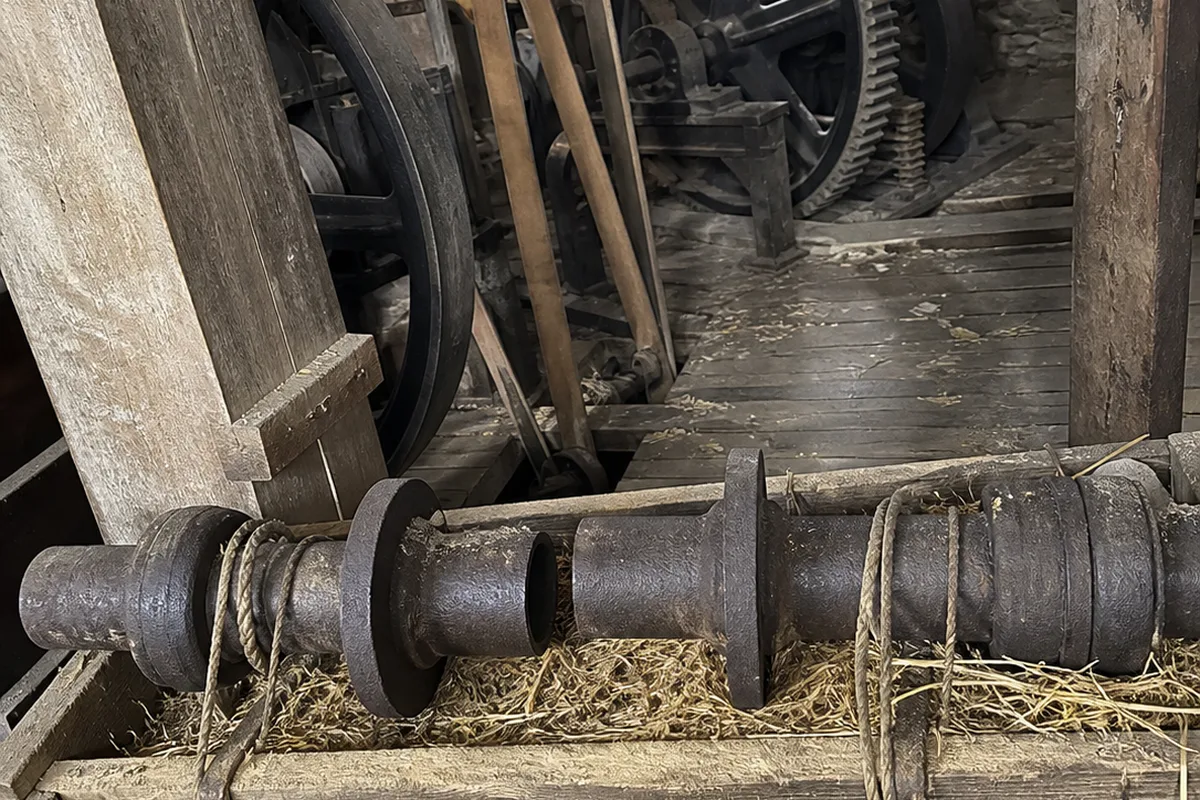
The plaintiffs in the case were Joseph and Jonah Hadley, millers who ran the City Steam-Mills in Gloucester, where they cleaned corn and ground it into flour and meal. One morning the crankshaft of the mill's steam engine snapped, and with it the whole operation came to a stop. The engine had been built by an engineering firm, Joyce and Company, in Greenwich, and to make a new shaft the makers needed the broken one in front of them to work from as a pattern. So the Hadleys arranged to send the fractured shaft to Greenwich.
To carry it they hired the defendants, the well-known carriers trading as Pickford and Company, run by Joseph Baxendale. A clerk was told the article was a broken mill shaft and that the millers wanted it sent at once. The carrier promised delivery the next day. Through the carrier's neglect, the shaft took several days longer to reach Greenwich than it should have. For every one of those extra days the mill stood idle, grinding nothing and earning nothing. When the Hadleys got their engine running again, they sued Pickford for the profits they had lost during the added delay.
The trial, and the question the judges reframed
At the first trial the jury found for the Hadleys, awarding £25 in damages beyond a sum the carriers had already paid into court. Pickford asked for a new trial, arguing that the judge had let the jury take lost profits into account when the law did not allow it. In 1854 the case reached the Court of Exchequer, and Baron Sir Edward Hall Alderson delivered a judgment that has been quoted in classrooms and courtrooms ever since.
The problem the court set out to solve was not whether the carrier had broken its promise. It plainly had. The problem was how far the consequences of a breach should reach. A late delivery can set off a long chain of losses, some ordinary, some freakish, and a rule that made a party answer for every downstream effect would expose anyone who signs a contract to ruin over a minor slip. The court's task was to draw a principled line between the losses a breaching party must pay for and the losses that, however real, fall outside its responsibility.
The rule the court wrote down
Baron Alderson's answer came in a single sentence that lawyers still call the two limbs of Hadley v. Baxendale. Damages for a breach, he said, should be those that may fairly and reasonably be considered as either arising naturally, in the usual course of things, from the breach itself, or such as may reasonably be supposed to have been in the contemplation of both parties, at the time they made the contract, as the probable result of breaking it.
The loss must arise naturally from the breach, or have been within what both parties could reasonably foresee when they made the contract. Losses outside both are too remote to recover.
The two limbs work as a pair of questions. First, is this the kind of loss that ordinarily follows from this sort of breach, the harm any reasonable person would expect? Second, even if the loss is unusual, were the special circumstances that make it likely known to both sides when they struck the deal, so that they can be taken to have contracted with that risk in view? If a loss answers neither question, it is treated as too remote, and the party who caused it does not pay for it.
Applying that test, the court held that the Hadleys could not recover their lost profits. The only things the carrier had been told were that the article was a broken mill shaft and that its owners were the millers. From those facts alone, the court reasoned, a carrier could not be expected to know that the whole mill was standing idle for want of this one part. Mills of the day might keep a spare shaft, or have other reasons for a stoppage; the lost profits were a consequence the carrier had no way to foresee from what it was actually told. Because the special circumstances had not been communicated, the loss fell outside both limbs. The court ordered a new trial with the jury instructed to leave the lost profits out.
What the case decided
The framework a delayed engine part forced the judges to set down:
Two questions, not one
Damages for a broken contract fall into two baskets: losses that arise naturally, in the usual course of things, from the breach, and losses that both sides could reasonably have had in mind when they made the deal. Anything outside both baskets is not recoverable.
Foreseeability at the time of the contract
The test looks to what the parties reasonably contemplated when they signed, not with hindsight after the loss. A consequence has to have been a probable result the parties could foresee then, or it falls away as too remote.
Special losses need notice
Unusual or hidden losses are recoverable only if the special circumstances were communicated to the other side, so both knew the stakes. The miller never told the carrier the mill was idle for want of the shaft, so the lost profits dropped out.
The rule outlived the mill
The two-limb test became the foundation of remoteness of damages in the common law. It survives in the Restatement (Second) of Contracts and the Uniform Commercial Code, and courts across the United States still apply it by name.
Why a Victorian carrier's late delivery still matters
The reason Hadley v. Baxendale sits at the front of every contracts course is that the line it drew is one commercial parties still stand on daily. A supplier ships late, a contractor misses a deadline, a software vendor's system goes down, and the customer's real damage is often not the price of the thing itself but the business it lost while waiting. Whether the party in breach has to cover that lost business turns on the same two questions the Court of Exchequer asked: is the loss the natural result of this kind of breach, and if it is unusual, did the other side know enough about the special circumstances to have that risk in mind?
American law absorbed the rule almost whole. The foreseeability principle Hadley set out runs through the Restatement (Second) of Contracts, which bars recovery for a loss the party in breach did not have reason to foresee as a probable result when the contract was made, and through the Uniform Commercial Code, which lets a buyer recover consequential losses only where the seller had reason to know of them. Courts across the United States still cite the 1854 case by name when they decide how far a broken contract's damages reach. The practical lesson it teaches has a modern echo in the way careful parties draft: a customer who wants to be sure a supplier is on the hook for lost profits will spell out, in the contract, exactly what is riding on timely performance, precisely because Hadley says the unusual loss travels with notice.
The case has not gone unquestioned. Legal historians have pointed out that Victorian mills commonly ran on a single crankshaft, which would make a shutdown after a break the ordinary and foreseeable outcome, not the exceptional one the court assumed. Scholars have also noted a tension between the reported facts, which suggest the carrier's clerk was told the mill was stopped, and the judgment, which proceeded as if the carrier knew only that the part was a broken shaft belonging to millers. Those debates have sharpened the case rather than unsettled it. The rule endures because the question it answers, how far liability for a broken promise should reach, has to be answered in every contract dispute over consequences.
A cracked piece of iron and a few days' delay produced one of the most durable sentences in the law of contract. It said, in effect, that a promise binds you to the losses you could see coming, not to every misfortune that follows.
That is the quiet discipline behind Hadley v. Baxendale: liability has an edge, and the edge is drawn where reasonable foresight ends.
Archivar
The Archivar Editorial Desk
Researched and fact-checked against multiple independent sources. General information for attorneys, not legal advice.
Sources: Hadley v. Baxendale, (1854) 9 Exch 341; 156 ER 145 (Court of Exchequer, decided 23 February 1854), the report via Justia; the case's entry in Wikipedia; Quimbee, "Hadley v. Baxendale Case Brief"; Chicago-Kent College of Law, Harris Contracts, "Hadley v. Baxendale"; Restatement (Second) of Contracts, Section 351 (unforeseeability and related limitations on damages); Uniform Commercial Code, Section 2-715(2)(a) (buyer's consequential damages); Richard Danzig, "Hadley v. Baxendale: A Study in the Industrialization of the Law," Journal of Legal Studies (1975).